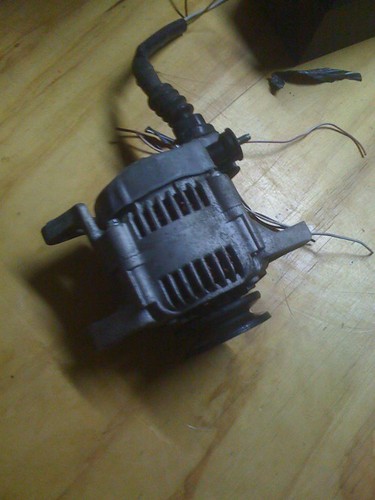
I had a minor mishap with my car, a broken tail light - some angry kid smashed a bin onto it. So I went to the wreckers and picked up a tail light. They had lots of alternators on the shelf, so I got one for the power generation gym project ( stationary excercise bikes hooked up to produce electricity, instead of consuming). A pilot has already been done in HongKong along these lines.
The trick with alternators as opposed to permanent magnet brushless motor I used in the past is that the field windings for the alternator need to be excited with a battery before it can produce enough power to be self exciting. This switchover can be done in theory using an Arduino to monitor the voltage levels, or something smarter to send the produced voltage out to the net.
Also exciting was LAM-MPI based processing once I figured out how to give separate hostnames to machines booting from the same NFS root image. Here is a script that makes use of the /etc/hosts file in the NFS root to assign separate hostnames to slave nodes.
ipaddr=$(/sbin/ifconfig eth0|grep 192.168|sed "s/.*addr://"|sed "s/\sBcast.*//")
host_name=$(cat /etc/hosts|grep $ipaddr|sed "s/[0-9\.]* //")
sudo hostname $host_name
Here is another option for automatic hostnames. Ideally it should be run after the system completes booting or as part of the ssh profile to change the hostname, so that when LAM-MPI starts the lock-files etc do not conflict. More alternate naming the better.
PS: Here is a very useful link for newer alternators
Monday, July 5, 2010
Friday, July 2, 2010
Taking Fiji Head On - Snorkelling and Playing Chicken
All the islands of Fiji have a collective population just below 1 million, this makes for a rather scenic and empty country in spite of its small size.
Day 1 was more like night 1, we arrived exhausted at 4pm. Had dinner on the beach at First landing resort in Vuda point. Next door is a Marina owned by a famous surfer. The Fijian apparently first arrived here and they have built something akin to a foot with sand to mark this.
Day2 was Sunday and everything seems to be closed. We borrowed a car and went off to play chicken ... Er for a drive down the Queen's Highway towards Suva. The highway goes all around the island, but is unfinished in some of the north-east. Fiji seems like sugarcane island from the highway. We strolled around the relatively new Intercontinental in Natadola, rode around in horses and dashed off to Sigatoka. Making a run to Suva seemed pointless at the end of the day, with deteriorating light and people tailgating and overtaking at 110km/h inspite of national speed limit being 80km/h. Finally dinner was at the steak house in Denarau, while checking out the boats which take people out on cruises to the smaller islands.
Day3 we hopped onto a refurbished english tall ship with Captain Cook Cruises. We were back after a remarkable day of snorkelling, shouting at a snake (possibly tiger snake) and the first Kava ceremony for the tour. Dinner again at a Fijian restaurant at Denarau.
Day4 was another trip back to Sigatoka and a bumpy ride upriver to Cannibal caves. We rafted across a very shallow river, silted up and prone to flooding. Water comes upto the waist if you walk in it. We were guided by a member of the Fijian cricket team into a limestone cave featuring a natural cannibal oven.
Day5 went past before we noticed, most of it was spent in the pool and the aeroplane. That's what happens when you plan holidays 1 day before hopping on a flight.
Thursday, June 24, 2010
BeagleBoard Stereo Camera on Flickr

Now I can produce unlimited amounts of stereo samples on Flickr for people to compute disparity maps. I will also put on an IR filter on one of the cameras and try capturing some 4 channel images at a distance where the perspective is not such an issue.
Wednesday, June 23, 2010
Introducing the Dog to the world - Prolink PHS101 modem on BeagleBoard
I seem to have sprouted an impromptu holiday to Fiji. So tonight ended up a rush in completing my papers for IGARSS 2010 in Hawaii. Time has passed so very fast. Some of my colleagues who started their PhD at the same time as me have written 1/3 of their thesis already. I in my turn have been distracted by life and side projects, but overall the extra curricular activities have made my PhD life much much more interesting.
While copy pasting content from my original draft into the conference template I decided to have another look at the tricky dual-device USB based 3G modems. The Prolink PHS101 is plugged into the BeagleBoard and appears as a pesky CD device on /dev/sr0, you can use mount -t iso9660 /dev/sr0 to access this device. The newer kernels fortunately and unfazed by this, using eject /dev/sr0 gets rid of the CD device and loads up the usbserial driver with the right vendor options to make it appear as 3 serial devices on USB. I did not have to use usb_modeswitch, though I managed to native-compile and install it on the beagle.
Only 1 of these 3 is a functional internet device. In Australia the wvdial.conf to make use of it looks something like:
Init2 = ATZ
Init3 = ATQ0 V1 E1 S0=0 &C1 &D2 +FCLASS=0
Stupid Mode = 1
Modem Type = Analog Modem
ISDN = 0
Phone = *99#
Modem = /dev/ttyUSB0
username = username
Password = password
Dial Command = ATDT
Baud =460800
Init4 = AT+CGDCONT=1,"IP","vfinternet.au"
Then I hit another brick wall, there is apparently an issue with wvdial which prevents it from working on arm based platforms. Modem-Manager and NetworkManager can be tasked into filling the hole left by wvdial. A bit of snooping with AT commands and ModemManager shows up the Qualcomm heritage of the chipset.
root@beagleboard:~# microcom /dev/ttyUSB0
ATI
Manufacturer: QUALCOMM INCORPORATED
Model: C-180
Revision: 120016_062_001 1 [Feb 09 2010 23:45:26]
IMEI: 358093021714293
+GCAP: +CGSM,+DS,+ES
OK
Wonder how soon I will be able to connect up using this.
PS: After finishing off my IGARSS papers I finally managed to get it going with a melange of dbus,nm,mm and pppd. So this modem officially works on the BeagleBoard, hurray!!
While copy pasting content from my original draft into the conference template I decided to have another look at the tricky dual-device USB based 3G modems. The Prolink PHS101 is plugged into the BeagleBoard and appears as a pesky CD device on /dev/sr0, you can use mount -t iso9660 /dev/sr0
Only 1 of these 3 is a functional internet device. In Australia the wvdial.conf to make use of it looks something like:
Init3 = ATQ0 V1 E1 S0=0 &C1 &D2 +FCLASS=0
Stupid Mode = 1
Modem Type = Analog Modem
ISDN = 0
Phone = *99#
Modem = /dev/ttyUSB0
username = username
Password = password
Dial Command = ATDT
Baud =460800
Init4 = AT+CGDCONT=1,"IP","vfinternet.au"
Then I hit another brick wall, there is apparently an issue with wvdial which prevents it from working on arm based platforms. Modem-Manager and NetworkManager can be tasked into filling the hole left by wvdial. A bit of snooping with AT commands and ModemManager shows up the Qualcomm heritage of the chipset.
root@beagleboard:~# microcom /dev/ttyUSB0ATI
Manufacturer: QUALCOMM INCORPORATED
Model: C-180
Revision: 120016_062_001 1 [Feb 09 2010 23:45:26]
IMEI: 358093021714293
+GCAP: +CGSM,+DS,+ES
OK
Wonder how soon I will be able to connect up using this.
PS: After finishing off my IGARSS papers I finally managed to get it going with a melange of dbus,nm,mm and pppd. So this modem officially works on the BeagleBoard, hurray!!
Monday, June 21, 2010
Ubuntu on Hawkboard and Statistics on SAR
The mind is a massively parallel device - at least at the neuron level. I am always doing multiple things simulataneously. Multiple in the sense of intellectual heritage, yet unified in a sense that I am doing something that interests me and I might as well call it an unique discipline - how to see at all parts of the spectrum or how to get to mars. In essence it is domain unified.
Last few days I have been looking at arm twisting the low-power DSP on the hawkboard into doing some image processing. Porting OpenCV to the DSP on beagleboard seems to be proceesing pretty well. I will have to build that and give it a try. For now I am satisfied setting up a dsplink enabled kernel and Ubuntu image from an SD card. The root image does not contain UVC drivers so I can't use my USB cameras, but at least the Hawkboard is operational. Time to switch attention to the BeagleBoard and give the dsp enabled opencv a whirl.
On the otherside I did some eigen decompositions of dual-polarimetric TerraSAR-X and PALSAR and noted how wildly different grasslands appear at L-band vs X-band. While L-band sees predominantly surface scattering, X-band is carried away by volume scattering. The X-band VV channel seems statistically most responsive to the pasture biomass, but the confidence of my statistics with only 33 sample points is rather rudimentary. The pastures are fairly dry (10% moisture) as opposed to wheat I have worked with in the past (50-60% moisture), this significantly reduces the radar cross-section and the net backscattering needs to be explained in terms of additional parameters. In this case there is significant influence from surface roughness and moisture content, backscattering increasing with increasing roughness and decreasing with increasing moisture content. Where the entropy is low I will investigate the negative-alpha filter for retrieving soil moisture.
In dual-polarimetry the alpha angle contains ambiguity and can often be misrepresented as multiple scattering. This ambiguity cannot be resolved without considering the actual targets of interest.
Friday, June 18, 2010
Chicken and Egg - SAR Data and Field work Data
In SAR Remote Sensing you often end up with rather chicken and egg scenarios. There is the empirical application oriented school which focuses on producing parameters like biomass and soil moisture from SAR backscatter, the other school is the electromagnetic simulation school which focuses on producing estimates of SAR backscatter from parameters gathered from fieldwork. My PhD aims to reconcile these 2 schools for dual-polarimetric SAR systems in L and X band. For all practical purposes this has become ALOS-PALSAR and TerraSAR-X data analysis. Though there is some chance of using the ProSensing PLIS system in L-band.
Forest study for biomass estimation and Soil moisture at L-band is well established due to the ERS sensors - Preliminary analysis of ERS-1 SAR for forest ecosystem studies. The same applies to C-band thanks to ENVISAT, RadarSAT etc. The use of X-band for these scenarios is relatively new and I am hoping to break new ground.
The PLIS system is currently producing bright curves from corner reflectors that everybody seems to be very excited about. Other things I am not excited about is the $1000 phone bill from few hours of internet browsing in Singapore. It looks ridiculous, 2 minutes costs some $100. I could have so easily used the freewifi from - wireless@SG. Also feasible is getting a cheap local sim, things to remember before I plug my modem in.
Wednesday, June 16, 2010
Torturing Data and Helicopters - Multivariate L/X band Regression
If you torture the data long enough, it will confess - Roland Cease. I have been messing with some PALSAR and TerraSAR-X backscatter over pastures for a while now and only reasonable relationship between field data and backscatter seems to be in the soil roughness. There are lots of explanatory variables for the strength of the backscatter and 2 response variables in different polarizations in the SAR. The challenge is to relate the impact of the explanatory variables measured at the relatively few field sites to the observations in the radar.
There are some interesting instances of EM38 usage where the readings are high due to proximity to power lines and the readings are high in the SAR due to scattering from the same. These match ups have nothing to do with soil moisture but everything to do with electromagnetics.

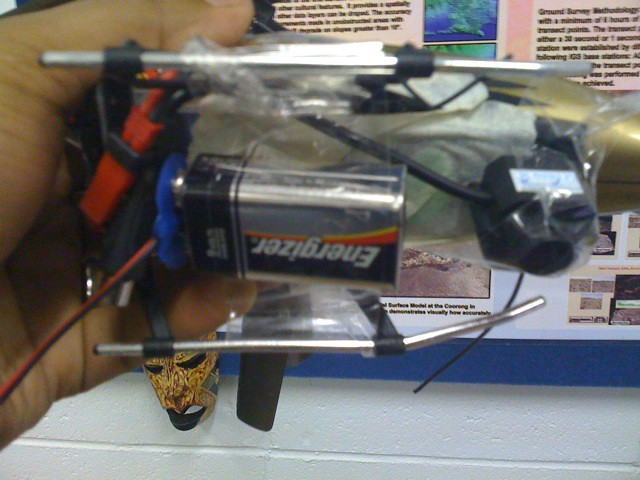
The mostly carbon fibre quadcopter has sprouted lots of aluminium extensions and will have a sizeable RCS now. Hopefully it will have sufficient power to fly. Something that definitely does not have enough power to fly is my little contra-rotor with the spy camera and 9V battery attached.
I will have to try flying the heli without the large 9v battery and just with some button cells stacked up to provide the same. Now there are rechargeable button cells from Telong making it feasible to deploy the camera with same recharge cycles as the helicopter main battery.
There are some interesting instances of EM38 usage where the readings are high due to proximity to power lines and the readings are high in the SAR due to scattering from the same. These match ups have nothing to do with soil moisture but everything to do with electromagnetics.
The mostly carbon fibre quadcopter has sprouted lots of aluminium extensions and will have a sizeable RCS now. Hopefully it will have sufficient power to fly. Something that definitely does not have enough power to fly is my little contra-rotor with the spy camera and 9V battery attached.
I will have to try flying the heli without the large 9v battery and just with some button cells stacked up to provide the same. Now there are rechargeable button cells from Telong making it feasible to deploy the camera with same recharge cycles as the helicopter main battery.
Subscribe to:
Posts (Atom)