Showing posts with label travel. Show all posts

Wednesday, July 22, 2026

Finding the Edge in Japan

Tsukiji Market smells like grilled seafood, wet stone, soy, tourists and logistics. Somewhere between the fish stalls and the slow current of people carrying breakfast on sticks, I walked into a knife shop and found a wall of edges pretending to be a retail display.

The commitment was not subtle. Rows of Santoku knives sat behind glass with the calm seriousness of lab instruments. Not the Don Quijote souvenir version, but the shops where the object is expected to do work for decades if you respect it. Around USD 250 felt like the going entry point for a decent Santoku in the places we wandered into, and it rose very quickly from there.

Then in Kyoto, the scale changed. A sword shop had a katana listed at 7 million yen. At that price you are no longer buying a long sharp object. You are buying metallurgy, lineage, polishing, paperwork, scarcity, and a whole cultural machine for deciding that a particular edge has survived long enough to deserve reverence.

Knives in Tsukiji Market

We visited two knife shops in Tsukiji, a sword shop in Kyoto, and another knife shop near the Pokemon Center in the Takashimaya building in Shibuya. The geography helped the idea settle. Tsukiji had the working-market feeling, knives as seafood infrastructure. Kyoto carried the ceremonial weight of blades as history. Shibuya had the polished department-store version, still serious, but now sitting in the same urban stack as Pokemon, fashion, food halls and escalators.

Japan does this particularly well: the ordinary tool is allowed to become obsessive without becoming kitsch. A kitchen knife can remain a kitchen knife while also being a small thesis on steel, heat treatment, hand skill, regional specialisation, and daily maintenance.

Sharpening as Culture

The part that caught me most was the sharpening. The edge is the temporary part of the knife. It is the part you create, lose, recreate, neglect, rescue and eventually learn to feel before you can see it. A beautiful blade with a dull edge is mostly theatre. A modest blade with a good edge is useful.

That is a very Japanese thing to make visible in a shop: the maintenance is not a sad afterthought after the purchase. It is the point. Stones, angles, pressure, slurry, patience. The object keeps working because someone returns to the boundary between metal and material and restores it.

The one time I got into trouble in Japan, amidst mostly friendly people, was in Tsukiji when I accidentally bumped someone sharpening a knife. There are mistakes that can be fixed with a smile, and there are mistakes where the animal part of your brain notices the blade first. I walked backwards slowly, muttering “gomen” with every available ounce of tourist sincerity.

Santoku knives behind glass

There is a pleasing physics to this. Cutting is not brute force. Cutting is pressure concentrated along a thin enough line that the material gives up locally. The wedge finds a gap, opens it, and moves through. When the edge rolls or blunts, the same hand and the same steel suddenly need more force, more damage, more mess.

That is where the metaphor starts doing actual work instead of sitting on the mantelpiece.

Sharp Words, Sharp Tools

We use knife language everywhere when we talk about thought. Smart people are sharp. Arguments have an edge. Teams lose their edge. We sharpen our axe when we build up skills before attacking the next task. We cut scope. We carve out time. We slice a problem into pieces. We decompose something hard into smaller pieces so the first incision becomes possible.

Doing new things often feels like pushing a blade into something that does not yet have a natural opening. You do not smash the whole surface. You look for the gap. You test the grain. You find the weak plane, the softer layer, the place where a small movement changes the geometry of the rest of the problem.

Software architecture has this hidden inside it. Debugging has it even more. A failing build, a strange sensor trace, a dataset that refuses to behave: none of these usually yield to force. You find the narrowest question that can split the problem. Does the voltage sag under load? Does the request fail before authentication or after it? Does the geospatial reprojection break before tiling or during the write path? A good diagnostic question is a sharp tool.

The wrong question is a dull knife. It still consumes effort, but mostly by bruising the work.

The Robot With an Old Edge

Then, at the space forum, I met Abhay, who has been working with a 1980s knife-sharpening robot.

That sentence felt like Japan had followed me home with a punchline.

The theme was suddenly not just knives as craft objects, but knives as an interface between craft and automation. A sharpening robot from the 1980s is old enough to predate most of our current robotics hype cycles, old enough to belong to the world of industrial control cabinets, teach pendants, custom jigs, limit switches, and stubborn mechanical repeatability. It has to keep the angle, pressure and abrasive contact honest while the steel pushes back.

Sword display in Kyoto

That is the useful tension. Sharpening looks simple until you try to automate it. The robot has to hold an angle, manage pressure, follow a changing profile, deal with abrasive wear, heat, burr formation and the awkward fact that every blade has a history. The edge is not a CAD line. It is a lived boundary on a piece of steel. The exact usage of the knife accumulates and determines its fate, reality is a stochastic process.

This is why robotics remains humbling. The easy demo is motion. The hard part is contact. Once a robot touches the world, the world starts negotiating back. Knives make that negotiation visible because the result is brutally honest. The knife is either sharp, or it is not. The tomato knows, as does the audience watching a Unitree humanoid lose the dance floor, or the Qualcomm Dragonwing IQ10 robotics platform show up in an ET NOW clip of a mid-presentation collapse.

Tools That Teach Hands

There is a lazy version of automation where machines replace skill, and a better version where machines expose what skill actually contains. A knife-sharpening robot is interesting because it cannot escape the craft problem. It has to encode something a human sharpener may feel through wrist, sound, drag and accumulated failure.

That makes it a useful object to think with. Japan’s knife shops showed the cultural end of the spectrum: reverence for the edge, the maker, the steel and the ritual of maintenance. Abhay’s robot showed the industrial end: repeatability, fixtures, kinematics, control loops and the stubborn desire to mechanise a subtle hand skill.

Between those two ends sits most serious engineering.

We do not build new things by being generally clever. We build them by maintaining edges. The edge of a discipline. The edge of a toolchain. The edge of a team that still remembers how the machinery works beneath the interface. The edge of a question sharp enough to enter a hard problem without shattering it.

The holiday version of Japan gave me knives behind glass, stones on counters, a 7 million yen katana, and Santoku knives priced like serious instruments rather than kitchen accessories. The space-forum version gave me a 1980s robot still trying to make an edge repeatable.

That is the thought I wanted to keep: sharpening is not preparation for the work.

Sharpening is part of the work.

Saturday, December 6, 2025

Darwin 2022 - Ruminations Compendium

Collected reflections from the July 2022 Darwin trip, a narrative of adaptation, organisational change, and expansion can live in a single place.

July 19 – Lemmings And Launchpads

There is no exception to the rule that every organic being naturally increases at so high a rate, that if not destroyed the earth would soon be covered by the progeny of a single pair. Even slow breeding man has doubled in twenty five years, and at this rate in a few thousand years there would literally be no standing room for his progeny. – Charles Darwin

Like the lemming marching and diving into the ocean to self‑regulate, humanity plunges itself into vices of its own creation: alcohol, drugs, violence, and greed. Perhaps the next plunge is into the real ocean or into the vacuum of space, chasing more room in which to stand or float. Failure in harsh environments creates room by removing weaker individuals, or greater resilience by rewarding the most adaptable. Colonial Australia itself was founded on such selection—the most adaptable individuals and the strictest rule enforcers reshaped an unforgiving frontier.

July 20 – Organisational Evolution In Flight

Seeing that a few members of such water-breathing classes as the Crustacea and Mollusca are adapted to live on the land, and seeing that we have flying birds and mammals, flying insects of vast diversified types, and formerly had flying reptiles. It is conceivable that flying fish, which now glide far through air, slightly rising and falling by the aid of their fluttering fins, might have been modified into perfectly winged animals. – Charles Darwin

The ability to skim over water for a few metres comes from external tweaks, but the ability to cross the Pacific like a Godwin Tern comes from internal rewiring: hollow bones, high metabolism, and a brain with a built‑in compass. Organisations face the same distinction. A brief digital-transformation spasm can bolt on an app or a website, yet sustaining that flight demands internal metamorphosis and a sense of direction from leadership. Caterpillars become butterflies through wholesale change—so must companies that aspire to be more than flying fish.

July 23 – Questions For The Corporate Naturalist

  1. Where are the transitional forms?
    Organisations with no lines on the org chart operate as pure adhocracy. Hidden behind corporate veils, they are like pupae in cocoons, waiting to emerge in a more defined shape.
  2. How can specialised organs evolve?
    Marketing machines, technology muscle, sales teeth, enterprise-planning backbone, analyst frontal lobes—each department is an organ honed for a specific survival task.
  3. Is behaviour or instinct inheritable?
    Culture answers this. The rituals, stories, and incentives that survive layoffs and leadership changes become the genetic code of the firm.
  4. Why are some species sterile when crossed, while others are fertile?
    Some mergers and acquisitions thrive; others fail because the two organisational genomes cannot integrate and diverge instead of hybridising.

July 24 – Conquering New Lands

He who believes in the struggle for existence and in the principle of natural selection, will acknowledge that every organic being is constantly endeavouring to increase in numbers; and that if any one being vary ever so little, either in habits or structure, and thus gain an advantage over some of that inhabitant, however different it may be from its own place, it will seize on the place of that inhabitant. – Charles Darwin

International expansion is a contest for ecological niches. Bringing hard‑won optimisations from one country to another is a bid to displace incumbents. The organisations that vary—by process, by product, by mindset—claim new ground first.

Sunday, October 6, 2019

Around Kenya in 4 days and a year ( part 2)

The New Year adventure continued past the sad mercury laden mines of Migori to the Tanzania border , Isebania in particular. We met up with professor Sangai Mohochi and had a brief gander into Tanzania ( Serere) for a beer. Later we had some Orokore Beer made from millet, we sat around a car tyre sipping still fermenting beer from straws.

We took our leave from the professor and had a long drive out to Rusinga island. A beautiful place without much of the tourist trappings lakeside places have. The Suba culture is being revived with festivals. We woke up early and did a trip around Rusinga Island and visited Tom Mboya's Mausoleum. One of my high school's illustrious alumni. 

After another long day of driving and some fiddling with charging phones directly from a car battery ( another story on how many engineers does it take to charge a phone), we ended up in Naiberi River Campsite. It is more like a glamping spot and ideal for a quiet New Year's celebration around a fire in the main hall.


A late lunch/early dinner at Rift Valley Lodge Golf Club. We went for a post dinner walk on the greens and ran into herds of zebras and antelopes. No wonder this golf club is classed as one of the best in the Africa. All the excitement was followed by an uneventful drive back to Nairobi.


We arrived tired but energized the beauty and possibilities in Kenya. The roads need to be built, electricity needs to be channeled to houses, there is a lot to do. We look forward to hanging around and getting it done. Eric is heading back to his PhD at Harvard, Gichini will be doing something about the weather prediction and I have helped put Lori Systems on a solid technical footing and change the Logistics landscape.

Saturday, June 22, 2019

KiCon 2019 - Chicago in a weekend

Getting away from a fast paced start-up to attend conferences is a hard ask. However I managed to get away for a few days to attend the inaugural KiCad conference in Chicago a few weeks ago.
The pace has been such that only after about a month I am getting a chance to write it all up. The first night I managed to attend the Hardware Happy Hour at the Ballast Point. I got to see some amazing stuff including pneumatics for an autoplaying piano using layers of PCB.
The huge selection of beers and the chicago dogs were definitely unexpected bonuses.
Tour of MHub assembly area with pick and place machine and large Molex sign. Also got to see Chris Gammell's desk and pick up some Amazon and Mouser shopping to bring back to Nairobi.
I could definitely use the pick-n-place machine in my house and I hope Chris makes use of it whenever he can.
I also got to speak to some companies I have worked with remotely but not met the principles and representatives in person, including CrowdSupply, Aisler, SnapEDA, Hologram and of course DigiKey. It was great to speak to the KiCAD dev team as well, perhaps I can contribute on the MSVC windows native build. I also managed to score credits freebies from all the sources.
Here are pure notes to self on various topics that I picked up on 2-days of super varied and dense conferencing. Some are commands I would like to run some, are techniques I learnt and some are pure stories I picked up.

Schematics are a drug, use code instead

  • pip install skidl

Auto-routers are evil but useful

  • Triangles (Topological/ Using TIN mesh)
  • Maze solving
  • Shape based ( Rectangles)
  • Channel Based
  • FreeRouting
  • Adaptive heuristics using deep learning
  • Linear increase in PCB complexity

High-frequency simulation (in GhZ range) for PCB's

  • OpenEMS ( MEEP)
  • Wilkinson filter
  • Important in Radar Design

Prototyping in a few hours

  • Isolation milling
  • Midwest Circuit Technologies
  • Bantam tools. Binary save.
  • 1/32" end mill 0.8mm tool
  • 10 mill trace

Rendering photorealistic PCB's

  • Render layers to image texture
  • Use Blender cycles based render with bump maps for silk-screen and traces

Contributing to KiCAD

  • Development in LaunchPad + Github
  • Starter bugs are available

More HF PCB's

  • 30MHz to 3Ghz, with narrow bins
  • 5.6GSPS digitizer
  • Tuned lines. Right angles create problems.
  • Use footprint, Arc or Trace around edge cuts.
I woke up pretty early on Saturday morning and walked around and almost hopped on a fire-engine tour. Always wanted to do that. Then I checked the radar, another thing missing in Nairobi, and a huge snowstorm was inbound. Snowstorms at this time in Chicago are atypical, but hey everyone stays in for the coference. By the time the conference finished and I headed home from the after-party everything was covered in snow.
The last day (Sunday) was spent taking an Uber Pool , a novelty for me, to a Vietnamese grocery and spending around 2 hours getting additional exotic food-supplies to bring back to Nairobi
I saw a Harvey milk tail fin and took to the skies back to hop across the Atlantic and Mediterrnean to Nairobi. Flying 40 hrs to conference for 48 hours and shop for 6 is a real pain. Will have to bring the KiCAD movement back home to Nairobi and pour more effort into the local hardware scene.
So long Chicago, see you next conference.

Wednesday, January 23, 2019

Around Kenya in 4 days and a year ( part 1)

2018 was a year on making impromptu decisions and hopping on random flights heading for adventure. In the beginning of the year I left Aerometrex to explore new opportunities at Lori.

It turned out I finished the year in similar markovian motion travelling around Kenya with a couple of high school friends. Thank you so much Eric for driving and showing us the beautiful country.

I received a call late on the 29th December proposing the trip. I booked a ticket of Safarilink and went to bed.  Flying out of Wilson Airport is magnitudes easier than flying out of Jomo Kenyatta International. I almost missed the flight, but the empty Christmas streets in Nairobi and low access overheads in Wilson meant I flew into Kisumu with zero dramas. I hopped in a Probox from Kisumu to catch up with the other 2 in Kericho. The Probox are known for being death machines, but is a super cheap and fast way to get around. There is another article somewhere revolving around the impact of the Probox on transport in Kenya.
Tiny Kisumu Airport
Safarilink Flight (Turboprop)

We then travelled via some roads still being built from the tea-gardens of Kericho to the lush sugarcame farms of Awendo. In sections the road meandered into farms and cars had to go in a single file and often backup into fields when a truck came by from the other side.
Road through Kisii
It was a great night of going out to watch football match in Ulanda town and staying at Owuor's Simba. The road from Awendo to Ulanda is awesome. The sugar cane is a mass scale project and produces a lot of bagasse which can be recycled into paper tissue and other products with the right infrastructure.

Mercury laden waters used to extract gold nodules

Sheds housing diesel engines and rock crushers for mining

Next day we took a side trip to Macalder gold mines. It was in interesting experience what people will do to earn a living in far flung places in the country. Migori county is known for its high concentration of mercury in water. The operations here clearly explain why. Rocks are dug up from underground gold mine and manually broken up into smaller chunks and ground into dust using diesel operated octagonal drum crushers. The whole place is noisy. The dust is then filtered to remove solubles and then mixed with mercury to form gold amalgam nodule, women (some of whom were pregnant) then stir the mixture by hand to find gold bits. Mercury is then recovered by retorting in small ovens and reused. At least some work is being done to raise awareness of the harm from Mercury, hopefully sanity will prevail over economic incentives.

We then continued our trip south towards Kenya Tanzania border and I will continue the story in another post.

Sunday, August 13, 2017

PyconAu 2017 - Melbourne

I recently attended my first PyconAu - a cauldron of programming goodness. It was held in cloudy and grey Melbourne at the convention center. The exact same venue I attended the Nvidia conference a while ago. It was three days of information flow and meeting very interesting people. I jotted down some quick notes in my Keep and I will flesh them out here for my own reference.

These were the sessions where I had more detailed notes and some photos:

GnuRadio Python bindings and simulator. SoapySDR. HackRF simplex hardware including a freaky demo of using playback attack to unlock cars by copying car remotes.
An update on the state of MicroPython. A live demo with I2C read from gyroscope controlling a servo. New stuff like help('modules'), upip install, VFS , assembler, Zephyr RTOS etc. Really got into this one. The idea of having line by line firmware building convenience and a REPL on an embedded device is oh so appealing.
The Murchison Widefield Array(MWA) and sampling the universe at 655MSPS - Rocket IO to Xilinix. FPGA Fourier variants and finaly 24 of 256 spectral channels trickling back to Perth at 10Gbps. The processing electronics is double Faraday caged to prevent RF feeding back into the telescope.
The messaging of data from IoT devices while minimizing data usage and allowing convenience and transfer of state. Various contenders are JSON, Avro, Protobuf and MQTT over Websockets or simple HTTP, with advantages in HTTP v2 due to header compression via HPACK.

Presentation featuring GUI's for IoT devices and a glowing orb seen in a famous Trump photograph. With interesting details about Progressive Web Apps and Javascript based IoT controls.
Another very very impressive demo came from Russell showing Python running on 6 different platforms on a few minutes. After that I should really checkout our BeeWare. Will have to write a full length article on it as well with a proper usage tutorial to earn these great looking challenge coins.

During the breaks people were leaving notes seeking jobs, offering jobs or setting a topic for a lightning talk. The looking for employees board was slightly daunting but I put up a brave little ad featuring Aerometrex anyway. I also gave a brave little talk about my LSTM and energy monitoring time series adventures.
The last day had this fun little guy controlled via Python and a Jupyter Notebook. On my list of toys to get to play with my son.
I also enjoyed the end of the day talk from Xavier on scientific data cleaning using Pandas was great as well. I quickly put it to use to clean my Tindie buyers list to send out a MailChimp Promo, not very scientific, but useful when you are running a crowd funding campaign. After that it was a couple of days of sprints and getting ATM90E26 to play nice with ESP32 and Micropython, that is another blog post altogether.

Monday, August 29, 2016

AWS Summit Sydney 2016

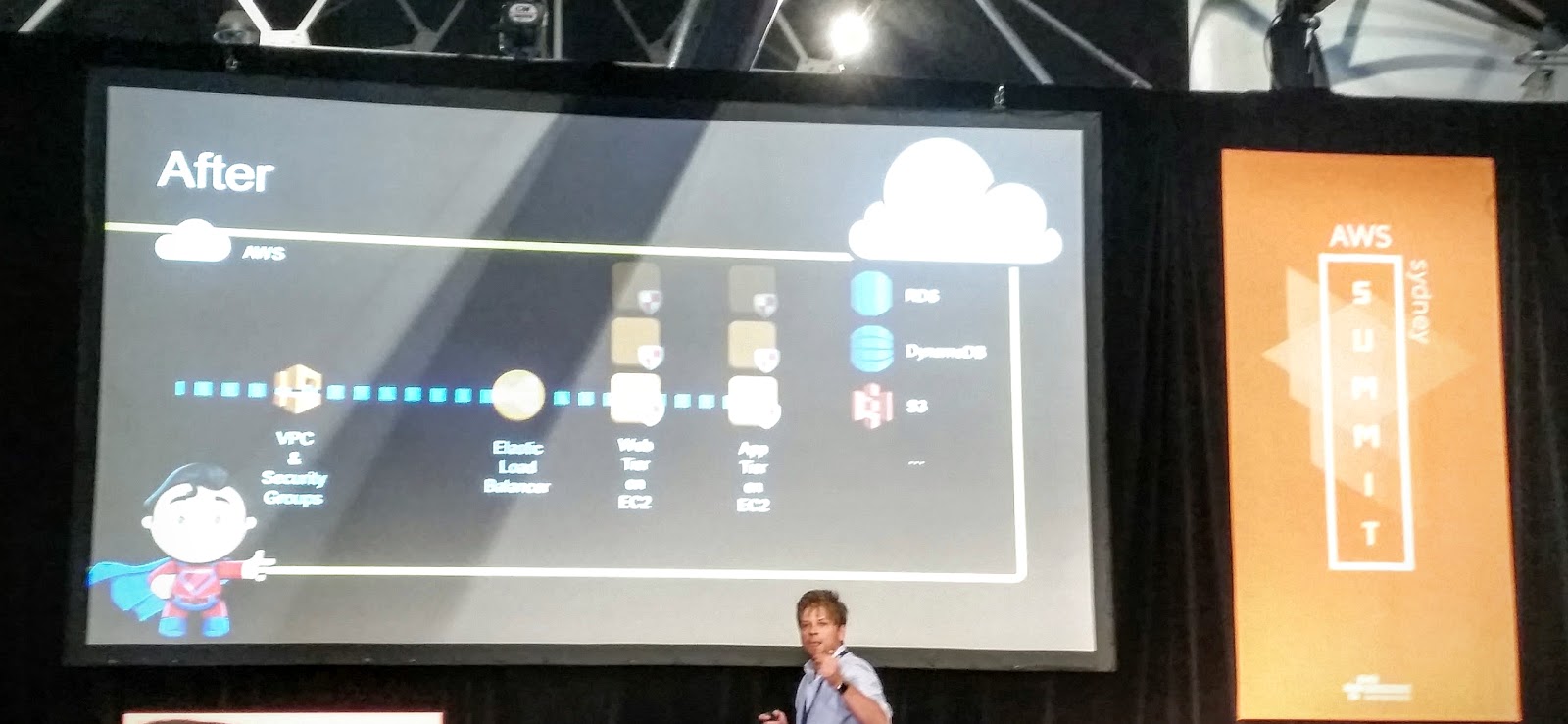
Any web application that targets a mass market and wants scalability ends up in the cloud, rather than in an individual data centre. Of all the cloud providers the biggest currently is Amazon. After running the metromap application with AWS for a year mostly on a self-taught basis I realized that it was time to rub shoulders with some experts and possibly bring in some help.
Amazon was hosting a sort of marketing conference in Sydney and unlike the academic conferences I am used to attending this one was free. So I signed up for it with some work backing.
On arrival I walked into a massive Kogan keynote speech, it had all the pomp and fanfare of a boxing match or WWF rumble. Felt very American.

There were lots of AWS customer stories including one by Origin Energy about customer analysis. They have over 100million customer interactions. Traditional meters are read only 4 times a year, while Smart Meters produce data at a 30min interval. With this data Origin can offer a fixed bill plan using predictive analytics. The creation of this service started in stealth mode hotel wifi and personal CC, interesting collision of corporate culture with internet realities.

Moving data to and from the cloud was big sticking point as well and the AWS Snowball (80TB) was announced. I have recently ordered one, still waiting for it to turn up. Will write another article on this Data Exchange unit once I have had a real life play with it. Working at an aerial photography company I am used to huge amounts of data coming in from aircraft on similar hard drive units, but none of them feature 10GB ethernet and in transit encryption like the Snowball does.


There was a big focus on IoT capabilities in AWS as well including an Earth, Air, Fire and Water demo with Alexa playing stage manager.


I had a small blast from my CSIRO past. Peter Blaine had a talk about IMOS data sharing. 50Million NetCDF's are up in the cloud. The big challenge being the heterogeneity of the data. Apparently they have moved to the warehouse next to my old office and things are progressing okay. Even though CSIRO is rapidly shedding science staff, the engineering half is still alive and well.
On the display floor I managed to knock over a remote presence bot and chat to a lot of people in various booths, including Sumo Logic and Puppet which were particularly relevant to my application of image serving and service monitoring.
After a couple of days of hard conferencing and networking I managed to get in some R&R and learn the weird game of shuffleboard and enjoy some cocktails at the Little Darlin'. It was an exciting couple of days in Sydney and since then I have been putting my knowledge to good use. I will write up another post from my mass of notes collected during the summit.


Wednesday, June 8, 2016

Kenya Trip 2016 - Magical Lamu

Arrving in Lamu on Flight 540
After about a week in Nairobi, Gichini and I decided to take a trip to Lamu to do get some R&R. Fly540 goes to Lamu almost every day and tickets are only about $100, the accommodation is cheap as well since the decline in the tourist trade due to the al shabab terrorist threat and abduction of westerners.As the article says Lamu is indeed a slice of paradise. Beautiful beaches, relaxed people and great food. I will try to keep this post low on words and let the pictures tell a story.

The Rasta men of Lamu
A lot of the people are ocean people. Fishing or transporting people in fibre glass boats with outboard motors or old school sailing dhows, a lot of which are made in Mozambique. One particular dhow was decked out with flags from multiple countries and had rastamen crewing it.
The beached dhow (made in Mozambique), prepping for a trip to Zanzibar
One of the downsides of the low tourist business is that we got approached by everybody who had something to sell. It made things affordable, but sometimes we overdid things a bit. On our walk from the airport ferry to the accommodation in Shela beach we met a guy who offered us fresh oysters. So we ended up with 4 dozen oysters for breakfast. The food overall was great, especially the fruits and seafood.
Oysters for breakfast

I took a day for a guided tour around Lamu old town. It has distinct Arab, Indian, Portuguese, Swahili sections. There are of course some modern areas as well. Building on an island is hard work, getting materials in and putting it together. A lot of the buildings are very old with marvellous hand crafted doors.
Old Wells

The Central Square
Some new buildings have replicated the old glamour and look like a set from a Medieval show (I am looking at you Game of Thrones).
New doors of old Lamu
The ocean seems to have crawled up and taken residence in the walls. Coral reefs have left their stamp.
Details in the coral lined walls
I took a day trip to a settlement from the 1500's with old walls and a secluded beach. Passed people from the Luo village quarrying limestone and coral by hand on the way.
Making charcoal the old school way
Quarrying for limestone
On the last day we took the boat back to the airport with friends we made on Shela beach. A glorious few days in an island paradise.I think I will go back as soon as I can.
On the boat back to the airport with Shay and Gichini
Beautiful isolated beaches on the Indian Ocean