Wednesday, May 25, 2011

Dragging Geotools kicking and screaming to OSGi land

Me and others have been making some noise on the Geotools list to convert the current modules in Geotools from being only modules in name to proper OSGi bundles with services being published for use by other bundles and packages being imported and exported cleanly.

There seem to have been several attempts to osgify the Geotools mud-ball with only the bits the users needed to get things done being taken care of and hard bit, particularly those using the Sun ServiceLoader interface being left out.
  1. Classic example from Harald Wellman currently hosted on Berlios
  2. Argeo attempt - Mathieu is putting the OSGi modification back into Geotools core
  3. Humboldt project - Same idea using Bnd.

There are 2 solutions to the META-INF/services dilemma (introduced by the classloader separation inherent in OSGi)
  1. A bundle lifecycle interceptor that picks up all the SPI based services and converts them to OSGi service.
  2. A compile time mangler that does the same conversion and adds OSGI-INF/*.xml for the services.
The reference factories being registered look pretty nice in ASCII art.

The other issue plaguing the migration of geotools is the presence of split package, another ripple from the OSGi classloader per bundle approach. There are various hacks to solve this, but none of them is quite neat. As a stop-gap package can be merged using the split directive in the manifest or via Bnd.

Hope the transformation will be over soon and we will have truly modular Geotools.

    Saturday, May 14, 2011

    Counting code - Ohcount vs Cloc

    We have lots of evil csh which we want to convert to bash or even perl or python. So I decided to test some code line counting tools to estimate the effort involved in terms of pure lines of code. I tested 2 options: the old and venerable cloc and the child of web 2.0 ohcount. Like the definition of the metre, what constitutes a line of code can vary a bit.
    Ohloh Line Count Summary
    Examining 16633 file(s)
    LanguageFilesCodeCommentComment %BlankTotal
    java273722755110247631.1%61095391122
    xml18148762754705.9%313496231
    xmlschema41869194874311.2%75378690
    javascript42341392938618.5%509655874
    html429196755802.9%202522280
    css8686976196.6%195111267
    sql1072892463.3%1687703
    xslt47309263617.1%5694297
    php260011015.5%102812
    bat11575223.7%166763
    scala5552356.0%99686
    python2954478659.1%4191749
    shell185029515.9%99696
    make6356246.3%78458
    Total603646770712922821.6%75759672694
    Cloc gives similar numbers off by a few thousand and separated by csh vs bash. Ohcount could do with some more shell script discrimination.

    Sunday, May 1, 2011

    Bringing back an old favourite - the Butteruino

    After I had done some damage with AVR's bought from Dick Smith in 2002 on a breadboard, I moved onto the butterfly. I did a mini project measuring waterflow using thermistors for GroGuard. Then they lay disused in boxes until recently. I ordered a carrier board from Ecross and put together a handy proto-typing platform, except the serial port on the butterfly I have seems to be obstinately broken.

    What could have been the #arduino , bring back the butterflies

    This did not stop me from getting some software together for loading code onto it. Since everybody has caught the Arduino fever. I decided to go with Wiring and the Arduino IDE to develop for the butterfly, fortunately the Butteruino project has already done a lot of the hardwork for me, I just upgraded the changes to v22 of the Arduino IDE release. The patch should go live on SVN soon. Till then if you have a butterfly and want to test it with the Arduino IDE get it here.

    Now the assembled carrier will lie in boxes till I work up the courage to order some more old butterfly's from Digikey.
    In spite of all their peripherals and fancy demo code, the butterflies suffer from the weirdness of the joystick, lack of FTDI for direct USB connection and overall fragility. Still they are excellent for long-term, low-power data logging applications, may be coupled with an Xbee. I believe given slightly different design choices, a better IDE than AvrStudio, no funny press the reset button and pray code uploads, the butterfly could have beaten the Arduino back then. I will look into making the flow sensor again once I get my hands on a working butterfly and develop some more Eagle skills.

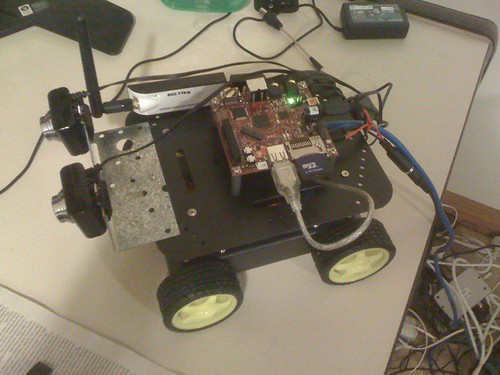
    Making wheel under the cameras - Beagle has 4 wheels

    All the work with stereo vision and kinect hackery is of not much use without obstacles to sense and avoid. Hence the beagleboard is now mounted on 4 DC motors driven by the DFRobot Arduino Romeo board. The robot base is quite sturdy aluminum and has plenty of pre-drilled holes, but to mount the beagle I had to acquire my first rotary tool set.

    Stereo vision robot taking shape I wish the wireless drivers on beagle were easier - ralink 2870 meh

    ASUS is coming out with the PC version (Xtion PRO) of Kinect soon, which will be smaller than the original and will not have the RGB camera, it will also be purely USB powered. Perfect opportunity to use it along with the stereo vision cameras to increase the depth of field and build a platform which can use vision indoor and outdoors and in complete darkness, by combining the sensors.

    Next comes getting data from the camera out wirelessly with sufficient bandwidth. I have the Beagle working with 3G modems, but this was going to be a first with a Ralink 2870 (which I got el-cheapo at DealExtreme) . With Koen's advice I decided to use the rt3070sta, the modinfo makes is obvious that this is going to work with the card:


    root@beagleboard:~# modinfo rt3070sta
    filename:       /lib/modules/2.6.32/kernel/drivers/net/wireless/rt3070sta.ko
    version:        2.3.0.4
    license:        GPL
    description:    RT2870 Wireless Lan Linux Driver
    author:         Paul Lin


    It does not like pumping dhcp at boot time so I have to go the long way and pull it up with ifup later on. The usual gstreamer tricks work fine for sending the camera streams around:


    In the beagle - gst-launch v4l2src device=/dev/video1 ! queue ! videorate ! video/x-raw-yuv,framerate=15/1 ! videoscale ! video/x-raw-yuv,width=320,height=240 !  ffmpegcolorspace ! jpegenc ! udpsink host=x.x.x.x port=xxxx

    In the laptop - usr/bin/gst-launch udpsrc port=xxxx ! jpegdec ! autovideosink

    Next comes pan-tilt and actual object avoidance and object following. Pass the dog a ball.


    Wednesday, April 6, 2011

    Expanding the Arm-AVR menagerie (Training Pandas)

    I have recently acquired some more hardware - a Tincan tools Trainer for xM and a Pandaboard. Sometimes I feel embedded should start with an 'A' - for ARM and Arduino.

    Word of caution in the new kernels the serial ports on the xM appear at /dev/ttyO1. Look in /proc/tty/drivers - OMAP-SERIAL  /dev/ttyO     253 0-3 serial.

    You will need this little tid-bit to program the trainer. The programmer seemed to be atleast respond to avrdude when fresh out of packaging:

    avrdude: stk500_getsync(): not in sync: resp=0x20avrdude -V -F -c stk500v1 -p m328p -P /dev/ttyO1 -b 57600 -U flash:w:blink.hex

    avrdude: stk500_getsync(): not in sync: resp=0x20

    It was not working anyway, but can I make it fail with 0x20 predictably ? So I got fancy and forwarded the serial port over the network. The beagle acts as a serial port server and the host machine acts as the client. This is plain tcp, but you can build an ssh-tunnel or whatever. The serial port is redirected with interceptty. The same failure was observed.

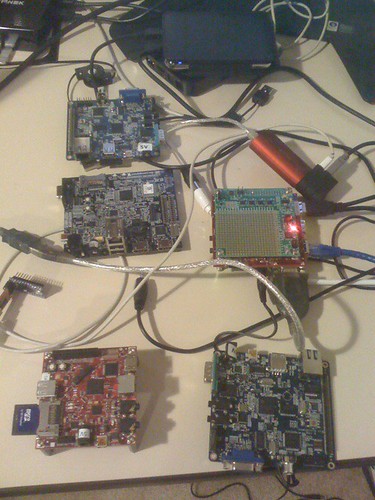
    The embedded platforms menagerie, and Avrs thrown in

    So I forked out some cash and got myself an ISP cable. This let me load the arduino bootloader using avrdude and the instructions here. After the first bootload, avrdude and avrgal can both push blink.hex to the arduino bootloader, but fail to perform further writes due to the lack of the software reset (stty -F /dev/ttyO1 hupcl). So I resorted to how the arduino visual IDE does things and eventually I used the Arduino.mk in /usr/share/arduino and built up a blink.hex which was significantly larger than the pure Makefile based one. This one supports loading and reloading via avrgal. The first attempt made an arduino bootsector virus as av500 put it.

    Now that all is hunky-dory in the tincan + beagle-xM world, it is time to attach a few peripherals to the arduino and watch it squirm.

    Wednesday, March 23, 2011

    Merry with Maven - Maintaining GEOS-3586

    I have been typing GEOS-3586 a lot of times this past week. The DDS/BIL plugin written for Geoserver 2.0.x had fallen by the wayside as things had changed on the WMS MapProducer(Response) front. This time it is going to be a serious push to get the plugin promoted from community module to extension status. I still need to get my head around GSIP-27 and GSIP-22 to efficiently continue maintaining this module.

    Finally I was recommended to just keep trunk updated and work towards getting the module moved out of community into extensions space. The DDS/BIL module has indeed a special place since it is the only community module extending map respones, all other map reponses are part of core. The extensions in response are mostly in the WFS area (OGR, Excel etc.).

    WorldWind in typical fashion throws some curve-balls at Geoserver: it uses BGCOLOR=-9999.0 for the elevation models instead of a hexcode. Fixing this will require dangerous interventions on the Geoserver side as outlined here by Andrea:


    The kvp parsers are at work way before the output formats
    get even into the picture.
    The class that parses bgcolor is ColorKvpParser.

    I think you can write a DispatcherCallback that hijacks the parsing and error
    reporting mechanism, but you have to be very careful to do so to avoid
    breaking the proper error reporting mechanism in other cases.

    In the init(Response) method of the DispatcherCallback you check the error,
    reset it to null if it's the one coming from the bgcolor parse failing,
    it is that special value, and the output format is one of the two that worldwind
    is using (use the raw kvp map to check the format and bgcolor values).

    Then you register that dispatcher callback as a spring bean in
    applicationContext.xml
    and GeoServer should automatically pick it and use it

    Please be very specific in the checks above or you'll leave users making
    wrong request in a world of pain (no error reporting and software blowing up
    in the most unexpected ways, or just ignoring what they set).
    I am also planning to include WorldWind (in an applet form) as a 3D layer preview tool  in Geoserver alongside Openlayers. Chris Holmes floated this idea a while back. Since I will be doing lots of work on WorldWind anyway, I can practice browser integration on the side in Geoserver.

    The plugin has some primitive documentation now as well - hacked together with my basic look-and-learn Sphinx-fu.

    Talking about putting things together - I finally migrated the content from my old blog into this one. Now just need a way to redirect all the posts to duplicates here and just keep the blog being deleted one.

    Friday, March 11, 2011

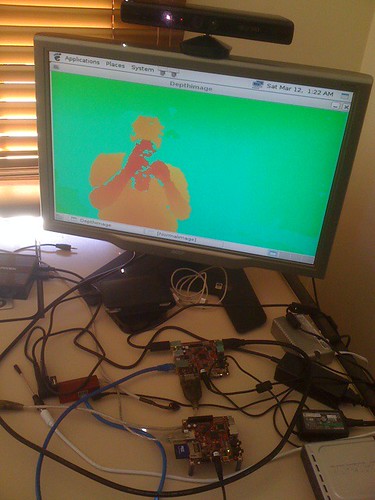
    Kinect + BeagleBoard-xM (now need GLES)

    My shiny new BeagleBoard-xM arrived a few days ago. I have been too snowed in with OSGi to spare it some time. The test image on the supplied SD card boots fine, but I have grand plans for a slamming robot vehicle which will require more goodies (probably eventually ros).

    It has become even easier to get started with kinect and beagleboard thanks to the inclusion of libfreenect master in angstrom. It can be almost plug and play.

      #beagleboard xM now works fine with kinect + opencv just need gles demos
    1. Install non-ramdisk angstrom. From windows the easiest way to get started is to download and SD image Koen graciously provides and burn it on top of the test image supplied with the board. As expected a few hiccups with the image writer but nothing a downgrade would not fix.
    2. Install libfreenect directly (opkg install libfreenect) or grab git/cmake etc. to build from source. Even when building libfreenect from source, having libfreenect-dev installed is handy since it fetches all the other headers needed.
    3. Make an OpenCV based demo, the standard demos don't work so well because the Beagle video driver lacks GLX. Need some more packages opencv, opencv-dev, compilers and whatever else. The building required a few symlinks for compilers and opencv libraries since I was compiling on the beagle itself rather than cross-compiling from oe.
    My TinCanTools xM trainer board with its Arduino will be arriving soon. The idea is to get a couple of servos and probably even a mobile robotics platform to start building an indoor track and shoot platform, with some slamming and co-operative map building thrown in. If anyone is interested in building a GLES client for the Kinect on the BeagleBoard let me know.