Friday, December 13, 2013

A few days in Samoa - Reefs, Thieves and Blue waters

We went to Samoa (the Western one not the American one) for a few days to experience sun, surf and the typical tropical paradise things. However paradises are very fragile, snorkeling is difficult since reefs are dying after a tropical cyclone, which flattened some of the best resorts.
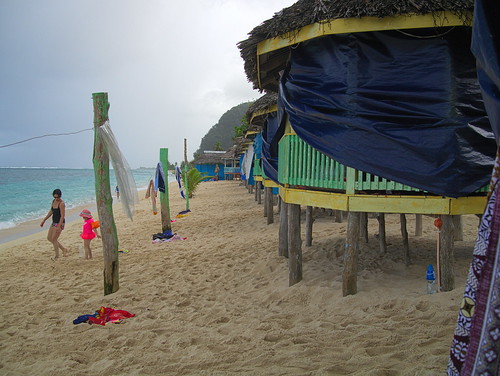
Beach Fales
Beach Fales along the Eastern shores of Upolu

Churches are everywhere, our resort was right next to a very large Methodist compound. The biggest building in Apia is probably the L.D.S. church with a shiny top. In spite of all the religious zeal the commandments are not obeyed, we had been warned about theft at the resort by TripAdvisor and it did happen. Some money disappears from our resort room, the police got called in to take statements from the staff. Only fair given Australian Federal Police is shoring up the policing in Samoa.
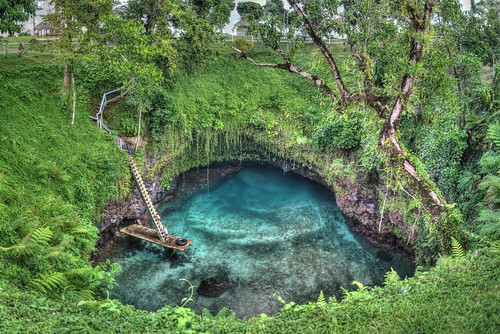
To-Suo Swimming hole
The To-Suo water hole at low tide

We drove around for a couple of days, getting througly lost and finding some wonderful places. Samoans only started driving on the left side of the road recently and about 50% of the cars are still left-hand drive, sharing the road with them is dangerous at best. I went off road for a bit and managed to get stuck in mud in pouring rain. A local thankfully came by and helped us extricate the car with some well placed planks.

Eventually we got to To-suo after repeated searching at opposite ends of Upolu. I had a stroll through the Livingstone museum and took photos of falls at sunset. Ate greasy food at the local market, stared at huge taros and rode the local bus (one of which was swept of a ford by a river the day after we left). I was a fun holiday overall.
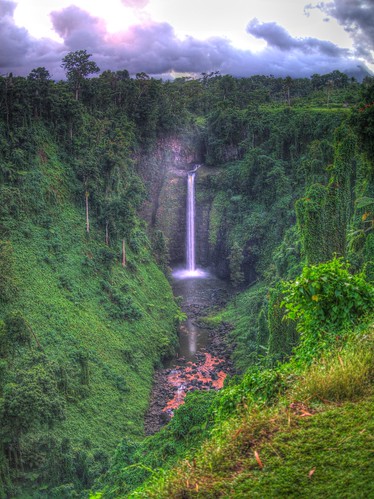
Sopoaga Falls
Falls near Falefa

Saturday, November 30, 2013

Reflashing BFL Jalapeno with UDOO

I funded the UDOO kickstarter a while back and received it a few weeks ago. The bot I was planning to put it on already has a controller, so the UDOO now lives a sad life as a BTC mining hub.
JTAG Port Pinout - Jalapeno has silk screen for 1 and 9

Testing the GPIOs on the UDOO manually
I have a couple of Jalapenos which I overpaid for on eBay and are all sold out due to Black Friday, but the prices are going up on BTC and I figured I could make them slightly more desirable for resale by performing a firmware upgrade. There are guides for performing the upgrade using the AVR-Dragon JTAG and the Raspberry Pi. Since the UDOO claims to be 4-Pi's in one it should be more than capable of running urJTAG using the GPIO cable and reflashing. The compilation took a couple of attempts due to the lack of back-up battery on the UDOO, every time I rebooted the time had an epoch reset and make got stuck in an eternal loop, eventually it settled down. You can also apt-get install urjtag, but that version does not have the GPIO cable.
UDOO GPIO pins used

On the UDOO we have a very large selection of GPIO's to choose from, for convenience I selected 4-near the edge - 88,56,105,89 and 144 for reset. Then used the Pandaboard GPIO toggling guide to get into the /sys/class/gpio file structure and quickly test these pins with an LED. The UDOO GPIO's are at 3.3v so it is safe to use them with the Jalapeno. I also colour coded the cables for future reference. Here is the table of the colours and pins on both the UDOO and the Jalapeno. The reset pin can be toggled using the LED testing method above to reset the board if you get stuck, simply output "low" then "high" to GPIO 144.
Cabling between Jalapeno and UDOO
Function Colour Jalapeno  GPIO
RESET Grey 6 144
TCK Yellow 1 89
TDO Purple 3 104
TMS Orange 5 56
TDI Blue 9 88
GND Black 2 GND
Once everything is connected fire up the Jalapeno and reflash it using the JTAG command chain below. I would really like to gather some statistics on the results of the detect command to see which CPU people have.
urJTAG reflashing of Jalapeno AVR
That's it, a great use for the many UDOO GPIO's go crazy and hook up 10 Jalapenos at once and run a reflashing service or send it to me for a reflash. If you found this useful BTC donations are welcome - 1JGoD1muFP5RiGPUWF12ncYz2WreYk35Rh .

Saturday, November 23, 2013

All forms of LTC mining - CPU and GPU (OpenCL/CUDA)

CPU mining is definitely deprecated. You never get the bang for power, unless you have machines with 32 cores and free power. Well at least for BTC. For LTC cpu mining (very slowly) is still feasible. Quite good if you have one of those 32 core - 128GB RAM beasts lying idle, or you are Amazon or Google. Just fire up pooler's minerd and take up a bunch of CPU's. A little bit of math shows EC2 CPU power will not be worth the investment, but with LTC prices heading north of $10 theres is no telling what people will try - including writing minerd into viruses. Amazon might stop EC2 service and start CPU/GPU miners itself.

CGMiner 3.7.2 with scrypt support can also get a fairly good rate on AMD Radeon cards with better OpenCL support. The ROI on these cards is definitely better than any of the miners in hand. Meanwhile people are pay AUD700 for 5GH BFL Jalapenos on ebay and joining the BTC bandwagon. Fun times ahead.

I am enjoying myself trading LTC/BTC and getting cheap thrills on penny stocks. Much better than when my horse (Verema) came last at the Melbourne cup, stumbled fell and had to be put down. I still won for last place. Even if like the horse, this vaporware currencies stumble fall and have to be put down they will leave behind legends and fiat currency millionaires.

Monday, November 18, 2013

Big Mole hill to fill holes - Meshlab

For a few days I was battling holes in a very dense mesh, a taste of which you can find here - Aero3Dpro. Meshlab is pretty handy for working with these, but there was a UI bug in edit_holes plugin preventing sorting of the holes to identify and squash the biggest ones. So in addition to filing a bug I decided to look into it myself.

There was a small run into the Qt change of ownership dilemma, tracking down the tools required some digging. Eventually I tracked down a working source set, had to compile it myself since the x64 binary I was depending on was built without QtScript support which Meshlab uses. By the end of all the trial and error I had 3 versions of Qt kicking around in my system - 4.8.0, 4.8.1 and 4.8.3. At least they all work for various projects.

Time to start writing my own meshlab plugins such as polygon based selection as featured in 3D Studio Max (called Fence Selection) or Cloud Compare(called Manual Segmentation). Also the Edit holes tool can be modified to automatically select larger holes to fill. Fixing up the textures to vertex colour transfer, since only the first texture is sampled -
path = path.left(std::max(path.lastIndexOf('\\'),path.lastIndexOf('/'))+1)
.append(srcMesh->cm.textures[0].c_str());

Also linking up with libLAS to allow LAS format saving with offsets and scale avoiding quantisation errors. More meshlab development to come.

Coming late to the party - Coin mining

Deep in the days of custom built ASIC miner boxes, mining with USB miners and hubs is considered a waste of electricity. Unless of course you are the government and own Three Gorges, still large miners are more efficient. Still I needed to get started and picked up a bunch of now collectors item - Icarus USB miners of eBay. Cgminer makes these really easy to use, with proper modules (in linux) or usb driver substituion with Zadig.

Next comes the fun part, choosing a pool to mine at. All say they are fair and there are so many pay-out algorithms, worth a PhD in economics by themselves for rewarding people for work done. Eligius has the CPPSRB, Bitminter uses PPLNS with donations. Some support all SHA256(SHA256) based coins, both BTC and NMC. Miners practice aggresive pool hopping (and currency hopping) to pick up the one with best luck. Some pools require registration, other just the payout address. All fertile ground for bots to play at.

After playing with BTC for a while I looked into LTC. Since it is still mined on the GPU (with scrypt CGMiner 3.7.2) and has less aggresive speculation. It might also just become irrelevant, but not being mainstream has some allure. Indeed these are the days of panning gold in early California or even closer to home at Eureka. Individuals issuing currency causes some disruption to monetary policy and governance. May be there will a tax put on selling mining ASICs, similar to a mining licence. Overall it is an intersting economic experiment.

Thursday, October 10, 2013

Short Holiday in Hobart - Meeting David Walsh

It has slightly more than a year since I left Hobart. I did make some very good friends, back here and I wanted to come back and catch up with them. Especially the people at MONA and fellow Salsa dancers, as well as the motley crew at the Prince of Wales. So when I was invited to visit MONA and catch up with David Walsh, I jumped at the opportunity.
While living in Hobart I used to visit the museum every Sunday. Funny how only religions are associated with regular activities, I must have signed myself upto the religion of feasting sense on the weird.

I went through the museum and noted all the changes since I was last there. Listened to the chatter from visitors and made some notes which came back to bite me when one of David's guest picked up my notebook.

David has made his made his fortune gambling. He is not the James Bond sort of poker player, rather he is a mathematician and sort of a programmer. I have some theories about why we persist in gambling in spite of the apparent losses to individuals.

Gambling exists to redistribute wealth, preventing it from accumulating over generations in one family causing resentment and decimation of the family through revolt and aggression from the rest of the society. Though decimation of powerful families does happen in spite of the gambling habits as shown by the Russian revolution or even more recently the Nepalese royal family. The best way to stave of socialism and revolts is for the wealthy to voluntarily dispense of their wealth in gambles. Just means of justifying wealth accumulated by David, under the nose of ATO. Apparently David used to work for the ATO before he declared himself dead and quit.


The conversation drifted to light rails for Hobart and the need for personal ownership of assets i.e. cars vs public infrastructure such as rails. This debate has been raging on even recently in the roads vs rails talk. A psychologist was around outlining a Jungian experiments in a Victorian mansion, people participating dreamt of fires. There were some stories about table tennis diplomacy and frame dragging, and lots of conversations with constant backup from wikipaedia.

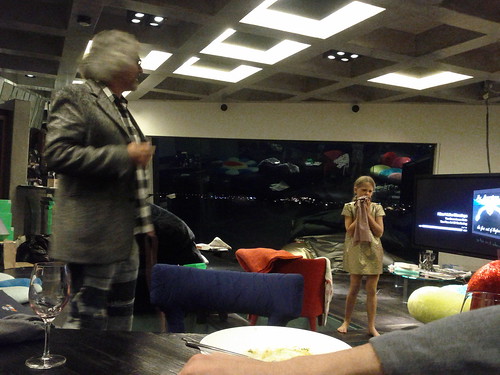
Dinner on MONA
I was invited to dinner at David's place with take-away from his restaurant. David and his wife are pescetarian. Dinner was followed by a David Bowie variety hour on Youtube and hanging out with the MONA music co-ordinator who has encyclopaedic knowledge of the songs. I finally slunk away rather dazed by the days events.

Tuesday, September 10, 2013

JPEG2000 Encoding with CUDA

For the last few days we have been struggling to efficiently write out very large JPEG-2000 files. In all their wisdom Erdas decided to supply only a 32-bit version of the ECW compressor. It seems to have trouble allocating memory for large JPEG-2000 files, is single threaded and dead-slow. Somewhere in the Ermapper install directory there is also the Kakadu core dll. So I decided to have a look at other methods of creating JPEG-2000, possibly faster and more scalable options. Kakadu seems to only supply an SDK and we can test the speed of compression with the SDK. GDAL also supports building against the Kakadu SDK and would be handy for creating the large mosaics we have been struggling with. It seems with modern hardware that is not the fastest option.

After some trial with Kakadu and a bit of reading I came across a few CUDA based implementations - CUJ2K and JPEG2K.  I decided to port the most recently maintained CUDA based JPEG-2000 implementation, claiming to be the fastest on commodity hardware to windows. The CMake based build system makes things easier. The code however was written for a POSIX based systems so I was missing a bunch of headers. I had to hack away at it and move variables around to cope with lack of C99 compliance in the MSVC C-Compiler or I am forced to used the /TP flag to upgrade the C-files to C++ files and allow variable declaration anywhere. Lots of moving variables around later, everything worked fine.

The compression library is built against FreeImage which functions as an I/O driver for the encoder/decoder. However only writing to the J2K profile is supported, a wrapper for the JP2 mode will be required to add-in all the projection metadata GIS Rasters typically require. To make this library more useful for GIS purposes we will need to add an I/O handler for GDAL instead of FreeImage to allow faster compression/decompression.

I have tested the JP2ECW, JP2OpenJPEG and JP2Kakadu drivers on a small file (26MB in .bmp format, since the Kakadu demo binary does not support LZW .tif I have lying around). The times averaged over a few runs on an i7-3930K @ 3.2GHz are shown below:
  • LibECW - 0.8s
  • Kakadu (1 Thread) - 1.5s
  • Kakadu (8 Threads) - 0.5s
  • OpenJPEG - 2s
Compared to these the CUDA library on the GTX580 on the same machine runs at 1.2s (with compression taking 0.75s, rest is I/O).  The logical next step is hooking up the compressor to GDAL for data-block I/O and building a JP2 wrapper in addition to the J2K profile which it currently uses. The Affero GPL licence also needs to be sorted out.


For those interested in the windows build, here is the SVN Diff against rev 84 and the pre-built release binaries against CUDA 5.5.