Showing posts with label conference. Show all posts

Saturday, June 22, 2019

KiCon 2019 - Chicago in a weekend

Getting away from a fast paced start-up to attend conferences is a hard ask. However I managed to get away for a few days to attend the inaugural KiCad conference in Chicago a few weeks ago.
The pace has been such that only after about a month I am getting a chance to write it all up. The first night I managed to attend the Hardware Happy Hour at the Ballast Point. I got to see some amazing stuff including pneumatics for an autoplaying piano using layers of PCB.
The huge selection of beers and the chicago dogs were definitely unexpected bonuses.
Tour of MHub assembly area with pick and place machine and large Molex sign. Also got to see Chris Gammell's desk and pick up some Amazon and Mouser shopping to bring back to Nairobi.
I could definitely use the pick-n-place machine in my house and I hope Chris makes use of it whenever he can.
I also got to speak to some companies I have worked with remotely but not met the principles and representatives in person, including CrowdSupply, Aisler, SnapEDA, Hologram and of course DigiKey. It was great to speak to the KiCAD dev team as well, perhaps I can contribute on the MSVC windows native build. I also managed to score credits freebies from all the sources.
Here are pure notes to self on various topics that I picked up on 2-days of super varied and dense conferencing. Some are commands I would like to run some, are techniques I learnt and some are pure stories I picked up.

Schematics are a drug, use code instead

  • pip install skidl

Auto-routers are evil but useful

  • Triangles (Topological/ Using TIN mesh)
  • Maze solving
  • Shape based ( Rectangles)
  • Channel Based
  • FreeRouting
  • Adaptive heuristics using deep learning
  • Linear increase in PCB complexity

High-frequency simulation (in GhZ range) for PCB's

  • OpenEMS ( MEEP)
  • Wilkinson filter
  • Important in Radar Design

Prototyping in a few hours

  • Isolation milling
  • Midwest Circuit Technologies
  • Bantam tools. Binary save.
  • 1/32" end mill 0.8mm tool
  • 10 mill trace

Rendering photorealistic PCB's

  • Render layers to image texture
  • Use Blender cycles based render with bump maps for silk-screen and traces

Contributing to KiCAD

  • Development in LaunchPad + Github
  • Starter bugs are available

More HF PCB's

  • 30MHz to 3Ghz, with narrow bins
  • 5.6GSPS digitizer
  • Tuned lines. Right angles create problems.
  • Use footprint, Arc or Trace around edge cuts.
I woke up pretty early on Saturday morning and walked around and almost hopped on a fire-engine tour. Always wanted to do that. Then I checked the radar, another thing missing in Nairobi, and a huge snowstorm was inbound. Snowstorms at this time in Chicago are atypical, but hey everyone stays in for the coference. By the time the conference finished and I headed home from the after-party everything was covered in snow.
The last day (Sunday) was spent taking an Uber Pool , a novelty for me, to a Vietnamese grocery and spending around 2 hours getting additional exotic food-supplies to bring back to Nairobi
I saw a Harvey milk tail fin and took to the skies back to hop across the Atlantic and Mediterrnean to Nairobi. Flying 40 hrs to conference for 48 hours and shop for 6 is a real pain. Will have to bring the KiCAD movement back home to Nairobi and pour more effort into the local hardware scene.
So long Chicago, see you next conference.

Sunday, September 16, 2018

PyconAU 2018 - Keep Notes

This is a raw dump of notes I took on keep while attending PyconAU. Each to be fully expanded to an article on its own. Suitably redacted to keep my intrusive thoughts to myself. 

Documentation and Technical Writing
  • Persuasive, Referential, Literary, Expressive. Writing pull requests. Foucault on discourse.
  • Think goals, Think audience, Write (structure, conventions). Active vs Passive (active is shorter). Bullets.
  • Plain English, easy words. Edit. Find good writing.
API Design
  • Forestry Data. User interface for developers. Access control , pagination. API versioning. Break in controlled fashion. Deprecation schedule.
  • Accept versioning header. URL Path versions. Less emotional versions. Small changes version transformer. Django middleware.
  • Auth- Token. OAuth.
  • Standardized (familiarity, avoid pitfalls, standards win) - jsonapi.org (next,.previous), graphql, Basecamp. Swagger.
  • Larger data sets out of band
  • Documentation. Selling page. Dev account, demo key, root url. Encodings, formats
  • OpenAPI, Swagger, tools, docs/code, reduce friction, automation.
Working with Spatial data in Python
  • Routing. Isochrones, Latte line.
  • Db spatial extension. Point in polygon.
  • Basemaps, JS library.
  • Geomesa.
Multi-lingual Python
  • i18n, l10n, language_code, locale, po (files translation). Language session choice flow. Url-conf.
  • trans and trans block tag. Every file must have the i18n tag. Use lazy in models.py.
  • makemessages in all depencies. Zh_cn.
  • Model fields to enter data. Keep tables in _zh_cn. Transifix.
Web without Javascript
  • Intercooler.js. CSOF… use web 1.0 submissions in a 2.0 way.
  • Large data. Out of-band.
Database optimization
  • Write amplification. Partial index. Hash, GIN(generalised inverse index) , BRIN (min/max)
Design for non-designers
  • Choose few fronts. Use different spacing. Curated fonts. Beautiful Web Type. Fontpair.co . Google Fonts. Making things clean (whitespace). Data analytics. Less is more. Unsplash, Photopin, Fiverr. Importance of imitation.
Designing environments with Docker
  • Front end builder. Task queue/Celery. Postgres. Docker compose .
Hypothesis to replace auto-manual tests
  • Hypothesis for testing by schema. Always true unless there is a bug. Fuzz the code with variety of input. Faker. Django integration push model and clean up. Quick check.
  • Generators.
  • Use lib2to3 parse through Python code and refactor / reformat. Bowler, safe refactoring for Python. Reuse refactoring code.
Tom Eastman - Keynote
  • koordinates, geospatial data. Effective learning for programmers. Effortful retrieval.
  • Fixed vs Growth mindset.
Lightning talks
  • DRF model pusher. Ably, Django Channels.
  • Claire Krause, GA satellite imagery analysis
  • Wrapt, allows introspection of wrapped functions. Context manager.
Many Python Web Frameworks
  • Cherrypy, Class based views. Falcon API first framework , fast, returns json for microservices. Hug with syntactic sugar. CCBV. Tornado, Async. Sanic.
Women in Python
  • Jason Fagon.
  • Katherine Johnson.
  • Carol Willing (Jupyter)
Celery and alternatives
  • Celery message formats, task chaining. Disable pre-fetch, long running. Own task queue. RQ (redis queue). Huey. TaskTiger(distributed locking). Dask (pydata), scheduler distributes pandas and numpy dataframes. Task chaining, celery import chain. RQ failed queue.
Trouble with sensor data
  • Kafka stream processing. React and Socket.io. HTML5 gyroscope API.
Pub conversations
  • RNN (Fast.ai), pre-trained model zoo.

Sunday, August 13, 2017

PyconAu 2017 - Melbourne

I recently attended my first PyconAu - a cauldron of programming goodness. It was held in cloudy and grey Melbourne at the convention center. The exact same venue I attended the Nvidia conference a while ago. It was three days of information flow and meeting very interesting people. I jotted down some quick notes in my Keep and I will flesh them out here for my own reference.

These were the sessions where I had more detailed notes and some photos:

GnuRadio Python bindings and simulator. SoapySDR. HackRF simplex hardware including a freaky demo of using playback attack to unlock cars by copying car remotes.
An update on the state of MicroPython. A live demo with I2C read from gyroscope controlling a servo. New stuff like help('modules'), upip install, VFS , assembler, Zephyr RTOS etc. Really got into this one. The idea of having line by line firmware building convenience and a REPL on an embedded device is oh so appealing.
The Murchison Widefield Array(MWA) and sampling the universe at 655MSPS - Rocket IO to Xilinix. FPGA Fourier variants and finaly 24 of 256 spectral channels trickling back to Perth at 10Gbps. The processing electronics is double Faraday caged to prevent RF feeding back into the telescope.
The messaging of data from IoT devices while minimizing data usage and allowing convenience and transfer of state. Various contenders are JSON, Avro, Protobuf and MQTT over Websockets or simple HTTP, with advantages in HTTP v2 due to header compression via HPACK.

Presentation featuring GUI's for IoT devices and a glowing orb seen in a famous Trump photograph. With interesting details about Progressive Web Apps and Javascript based IoT controls.
Another very very impressive demo came from Russell showing Python running on 6 different platforms on a few minutes. After that I should really checkout our BeeWare. Will have to write a full length article on it as well with a proper usage tutorial to earn these great looking challenge coins.

During the breaks people were leaving notes seeking jobs, offering jobs or setting a topic for a lightning talk. The looking for employees board was slightly daunting but I put up a brave little ad featuring Aerometrex anyway. I also gave a brave little talk about my LSTM and energy monitoring time series adventures.
The last day had this fun little guy controlled via Python and a Jupyter Notebook. On my list of toys to get to play with my son.
I also enjoyed the end of the day talk from Xavier on scientific data cleaning using Pandas was great as well. I quickly put it to use to clean my Tindie buyers list to send out a MailChimp Promo, not very scientific, but useful when you are running a crowd funding campaign. After that it was a couple of days of sprints and getting ATM90E26 to play nice with ESP32 and Micropython, that is another blog post altogether.

Monday, August 29, 2016

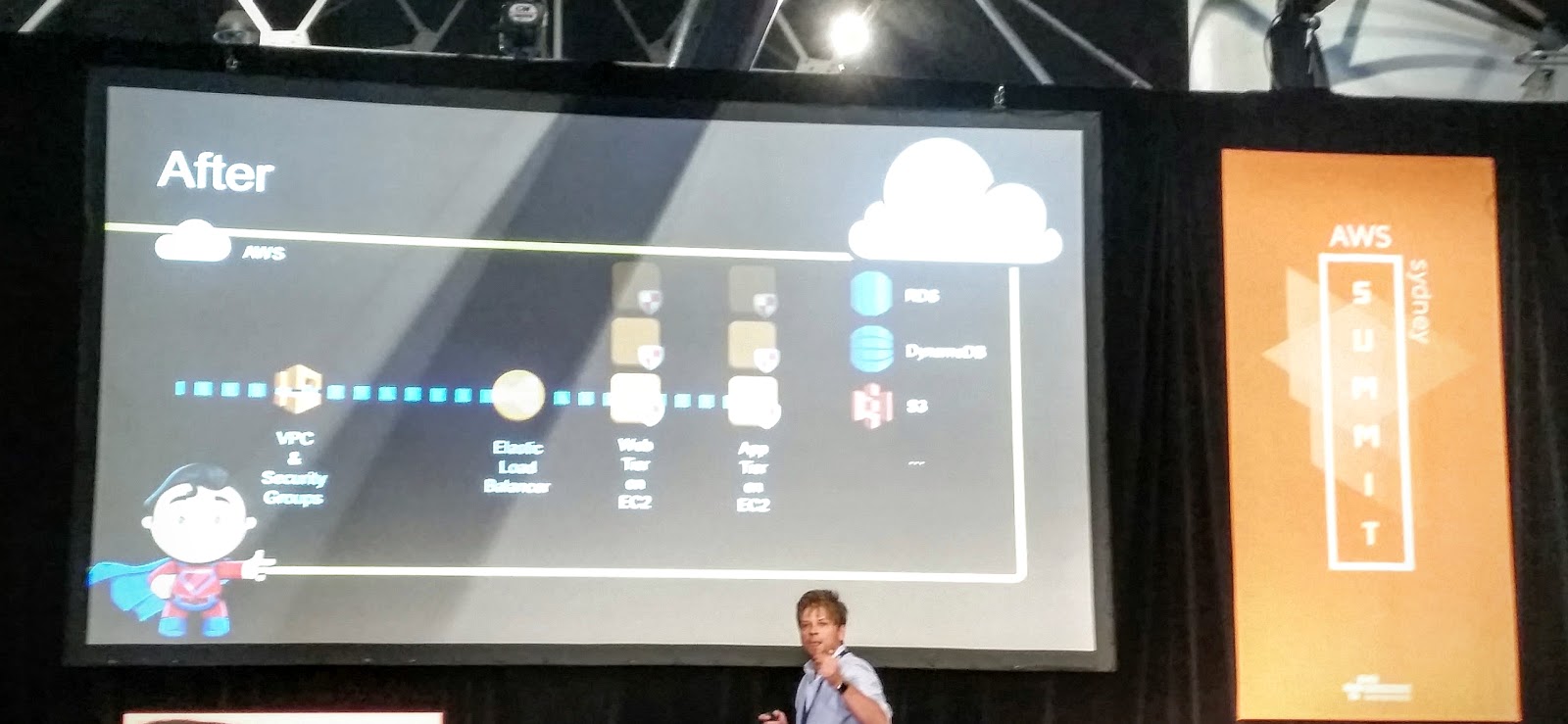
AWS Summit Sydney 2016

Any web application that targets a mass market and wants scalability ends up in the cloud, rather than in an individual data centre. Of all the cloud providers the biggest currently is Amazon. After running the metromap application with AWS for a year mostly on a self-taught basis I realized that it was time to rub shoulders with some experts and possibly bring in some help.
Amazon was hosting a sort of marketing conference in Sydney and unlike the academic conferences I am used to attending this one was free. So I signed up for it with some work backing.
On arrival I walked into a massive Kogan keynote speech, it had all the pomp and fanfare of a boxing match or WWF rumble. Felt very American.

There were lots of AWS customer stories including one by Origin Energy about customer analysis. They have over 100million customer interactions. Traditional meters are read only 4 times a year, while Smart Meters produce data at a 30min interval. With this data Origin can offer a fixed bill plan using predictive analytics. The creation of this service started in stealth mode hotel wifi and personal CC, interesting collision of corporate culture with internet realities.

Moving data to and from the cloud was big sticking point as well and the AWS Snowball (80TB) was announced. I have recently ordered one, still waiting for it to turn up. Will write another article on this Data Exchange unit once I have had a real life play with it. Working at an aerial photography company I am used to huge amounts of data coming in from aircraft on similar hard drive units, but none of them feature 10GB ethernet and in transit encryption like the Snowball does.


There was a big focus on IoT capabilities in AWS as well including an Earth, Air, Fire and Water demo with Alexa playing stage manager.


I had a small blast from my CSIRO past. Peter Blaine had a talk about IMOS data sharing. 50Million NetCDF's are up in the cloud. The big challenge being the heterogeneity of the data. Apparently they have moved to the warehouse next to my old office and things are progressing okay. Even though CSIRO is rapidly shedding science staff, the engineering half is still alive and well.
On the display floor I managed to knock over a remote presence bot and chat to a lot of people in various booths, including Sumo Logic and Puppet which were particularly relevant to my application of image serving and service monitoring.
After a couple of days of hard conferencing and networking I managed to get in some R&R and learn the weird game of shuffleboard and enjoy some cocktails at the Little Darlin'. It was an exciting couple of days in Sydney and since then I have been putting my knowledge to good use. I will write up another post from my mass of notes collected during the summit.


Tuesday, November 15, 2011

OSDC 2011 - MiniConf Redux

Last couple of days I hung around Canberra attending the OSDC in ANU and drinking gallons of orange juice and tomato juice in pubs.

The morning was spent catching up on PHP. I learnt stuff like traits, hiphop (via Facebook),  odata (via Microsoft),

On the first day I assisted Jody in running the Geotools workshop. Only a small fraction turned up with laptops, so it was a rather cozy session. I met some old acquaintances again - Matt Paget from CSIRO Black Mountain (TERN) and Kelvin from Adelaide Uni now at DSD.
Osdc geotools students
Osdc geotools the teacherWe celebrated the after conference party at a quiz night, where team OSDC consistently got the lowest score and I learnt trivia like there have been 5 different images of the queen on the Australian coins. The second day was a mad Arduino rush. I acquired an Arduino Uno via Littlebird and lots of wisdom concerning making PCB's and making lights blink in fancier and fancier ways.
Apparently once you have fallen in love with Ferric Chloride you will never go back to anything else for etching. I now just need to find someone to come and have a look at my etchings.

Sunday, April 11, 2010

PIRR Review - Radars are everywhere

Last week I attended the PIRR (Progress in Radar Research) workshop sponsored by DSTO. As expected it was full of DSTO employees from various parts of the country as well as some University people.

Zheng Shu from  CSIRO CMIS had the most relevant presentation pertaining to my research area. CSIRO and UNSW are developing techniques for combined use of Landsat and PALSAR for forest monitoring in Tasmania.

There were also talks dense with applied mathematics and beam forming. Some where people were tracking artillery shells with HH/VV radar, even though the shell is symmetric and did not have much difference in cross-section in the 2 polarizations. Then interesting spotlight views of ships from Ingara.

I also saw a very small and neat K-band (24 Ghz) dual-pol patch antenna used for termite detection. Getting closer to a flying radar in the lab then, hope there are no termites around.

Wednesday, July 29, 2009

Back in Kenya via Cape Town

So I am getting to write another blog entry within 2009. I have rarely used the blog to express myself since I started using Facebook. I guess a blog has less sinkage from a million of other entries.

Anyway I am back in Kenya visiting my parents and organizing reunions for Mang'u Y2K. In this trip I also went to South Africa and presented at IGARSS 2009. My work got positive comments from J.S. Lee which was a big plus.

We had a standard reunion at Kengeles on Koinange street and got to catch up with people I haven't seen in 9 years.

Then I squeezed in a couple of days in Zanzibar just to run around at the beach and visit the world heritage stone town. I also got to learn a lot about spices, wonder if it will improve my cooking.

Today I am supposed to give a talk on how I have fared post high school at Mang'u and inspire the current students. I wonder if I will do a good job.