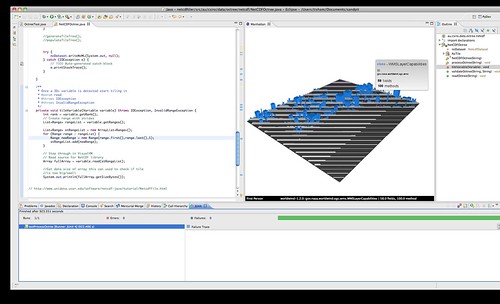
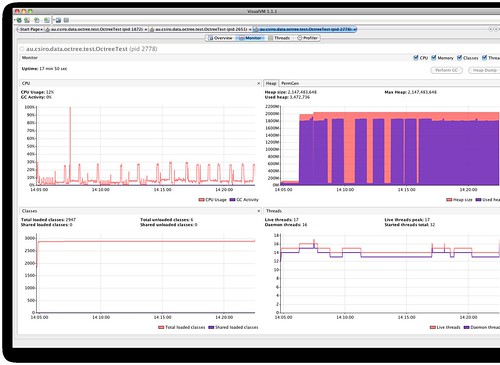
Patrick at NASA is amazing at putting people together, he put CSIRO Marine and Atmospheric Research ( who provide my daily bread currently ) , ORNL , NOAA and NASA itself. This project aims to visualise space-time resolved datasets in the globe context. With proper planetary projections on any object.
We had internally started building blocks of a large modular data visualisation framework called TrikeND, this was a natural choice to attach it to the globe context via worldwind. Even though scientists often prefer to see the data in pure form without being attached to the globe, so we have alternative renderers such as VTK and Jzy3D in the sights in addition to iGlobe. The primary data source is NetCDF, but we also provision GIS formats via Geotools, I put in sometime experimenting with OSGification of Geotools, with lots of help from Mathieu and Jody. This is designed to carry on from our legacy product DIVE.

iGlobe focuses on addressing the following issues:

1: Streaming large datasets from where they sit to where they are viewed. We would like to use standard protocols where possible, especially WCS NetCDF profile and OPeNDAP.
2: Providing heuristics to identify the right fields to be visualised as scalars, vectors and tensors.
3: Different display techniques for rendering scalar and vector fields, including volume visualisation with voxel and slice based techniques, display lists, vertex array, VBO , true impostors and other usual suspects.
4: Coherent time-locked animations keeping all the layers in sync in real/model time domain.
5: Transparent analysis techniques running on small problems on the client side and calling on server resources for large problems. Varun has been implementing various data mining techniques including FFT, change detection and anomaly detection.
There is lot more to come including an opportunity run iGlobe as part of an experiment on the ISS.
We had internally started building blocks of a large modular data visualisation framework called TrikeND, this was a natural choice to attach it to the globe context via worldwind. Even though scientists often prefer to see the data in pure form without being attached to the globe, so we have alternative renderers such as VTK and Jzy3D in the sights in addition to iGlobe. The primary data source is NetCDF, but we also provision GIS formats via Geotools, I put in sometime experimenting with OSGification of Geotools, with lots of help from Mathieu and Jody. This is designed to carry on from our legacy product DIVE.
iGlobe focuses on addressing the following issues:
1: Streaming large datasets from where they sit to where they are viewed. We would like to use standard protocols where possible, especially WCS NetCDF profile and OPeNDAP.
2: Providing heuristics to identify the right fields to be visualised as scalars, vectors and tensors.
3: Different display techniques for rendering scalar and vector fields, including volume visualisation with voxel and slice based techniques, display lists, vertex array, VBO , true impostors and other usual suspects.
4: Coherent time-locked animations keeping all the layers in sync in real/model time domain.
5: Transparent analysis techniques running on small problems on the client side and calling on server resources for large problems. Varun has been implementing various data mining techniques including FFT, change detection and anomaly detection.
There is lot more to come including an opportunity run iGlobe as part of an experiment on the ISS.