Showing posts with label forest. Show all posts

Sunday, February 10, 2013

Living and dying in the Sunderbans

This is a well established wikipedia fact the the Sunderbans are the world's largest single block of Mangrove forests. It is difficult to grasp the scale and density of it unless you are drifting around in the countless rivers cris-crossing it for an entire day. A couple of days ago, I did just that. Nothing as dangerous as what the locals do - strolling into the deep forest with a pass bought for AUD50 or so and spending days at end collecting fish and honey. Occasionally falling prey to tigers or crocodiles. At least they get to see the elusive tiger briefly. They keep doing it since profit margins are huge, some AUD4000 per month, better than sitting exams and waiting for a government job.
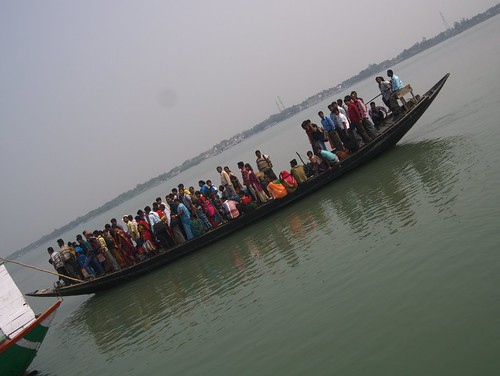
Public river transport
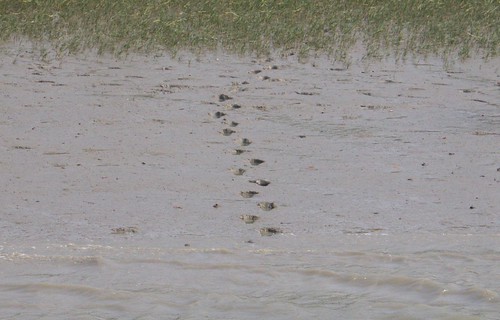
On the same day we saw human footprints heading into the jungle and after drifting around a bit more tiger footprints crossing the river. Crocodiles were everywhere, sunning themselves. We even saw a juvenile croc, looked rather harmless. One of the anecdotes we picked up was about a tiger losing his back legs to a croc while crossing the rivers.
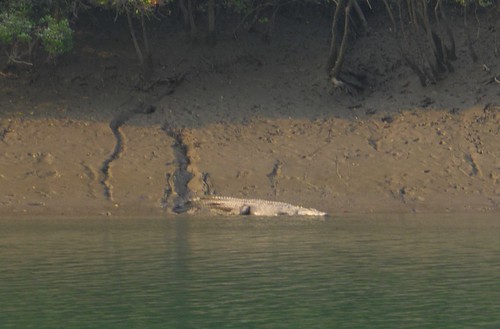
The khal and kumir 
Those who don't earn their living from the forest have taken to clearing it and planting rice. The conservation efforts are ongoing to protect the forest and reduce land clearing. The big cyclone in 2009 - Aila, caused stormsurges and deposited salt on most of the rice fields. This has sent people back to the forests, until the salt tolerant rice comes along. The other noticeable thing was the profusion of solar panels, since most of this area is off the grid. Often there were separate panels supplying separate rooms and one clearly identified for the TV, attached to a satellite dish.
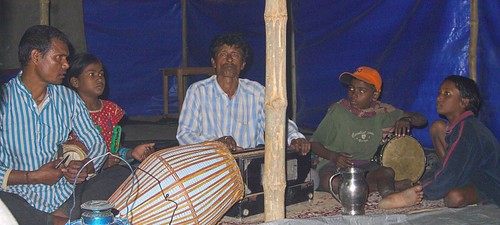
The musicians
The television is a rarity only afforded by the rich. The local live music and theatre scene seems to be pretty active. You can often spot musicians on the ferry heading to a gig on a pushbike with a dhol strapped to their back. Tourism is catching up to provide some more support and even more exposure for the area. It provides an alternative to "jungling", our cook lost her husband to a tiger. However local tourism can be quite destructive, since the locals tend to dump rubbish everywhere and get drunk and drown themselves in the river. Not much different from stories I read about Australians in Laos.
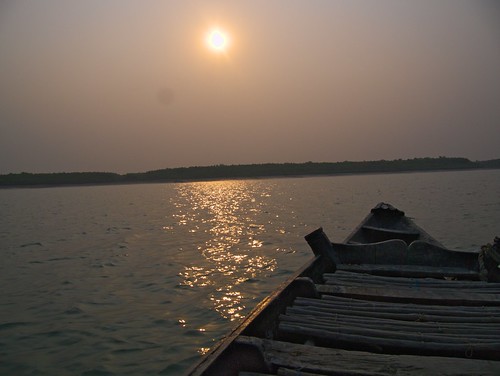
Sunset boat ride
It is a beautiful place, but in the danger of disappearing under the pressure of people. The great economic importance the forests have in their non-destructive use is keeping them from destruction. Things may go slightly awry if urbanisation finally catches up, being off the grid is actually good for this place.

Two weddings and Tiger Footprints

It is that time of the year when I visit my family in India and throw in a drive by tour of another place in Asia. This trip is almost round the world in its scope - Adelaide, Singapore, HongKong, Kunming, Kolkata, Dubai .... back. There are always memorable things at each spot. Singapore airport is just too familiar, but on 2 flights I sat next to Capgemini employees flying in and out of China (from Australia and to India). Something huge is brewing.

Hong Kong skyline
The highlight of HongKong was the busy life-style, crazy shopping and the hybrid cultural wedding. The lights make for great photography and testing out of my new 4/3 camera. Some serious lens shopping coming up. The wedding was a fun, great venue, good scale and +Rowan Fry looked understandly over the moon. The best part was the entrance in traditional chinese gear, he would have made a rather respectable official in imperial china. I wish them a happy life together.

Last week I attended another wedding in Bengal. The contrast was stark, the rush, the colours, the food. The only thing that was constant was the hot wire cut foam decorations, the flowers and the suit I wore to the other wedding. The wedding invitations extend to whoever bothers to come, I hardly knew anybody, not even bride and the groom. Felt a bit like a wedding crasher, till we went to see the bride's dad, he was laid up with all the stress from getting the feast organised for some 600 people.
Devil is in the detail
The last few days we toured the Sunderbans with a Backpackers group aimed at foreigners, much more relaxed than trying to do it packed like sardines in local style. There seems to be zero-respect locally for the Sunderbans, since the majority have not been lucky enough to see the tigers, all believe no tigers exist. They should perform 3D photogrammetry on tiger footprints, lay out some tiger sized dolls and change the holiday season to coincide with tiger mating season. Only then will people believe tigers do exist. Saw plenty of crocs though and some crazy tourists to keep us company. I was both local and foreign, had fun teaching Bengali - managed to teach a Canadian to count to ten. Should start some word association based Bengali learning kit.

Tiger paw prints

Monday, October 24, 2011

Carbon Accounting and Mine Sweeping in The Tarkine

Last week I had a super-long weekend thanks to the Hobart showday public holiday added to burning one day off my annual leave. Instead of enjoying the g-forces on offer at the show I went to the Tarkine with TWS to do some more community carbon accounting.

We stayed near Edith Creek , I obstinately refused to take a bed and occupied the drawing room floor. We covered 6 or so sites in a couple of days. The first day was mostly spent driving up and setting up camp. One of the most interesting sites was along a creek, the ground was full of burrows made by mini mud crayfish. 

We also the proposed site of the Shree open cut iron mine and  took some group photos.

Sunday, October 2, 2011

Carbon Accounting in Blue Tier

Last weekend was full of veriditas, I did community carbon accounting with the Tasmania Wilderness Society. It was my first time bush bashing in through one of the older Tasmanian forests. The trip to Mt. Fields was way more touristy than this.

I had the privilege of wearing the Tasmanian Devil costume and posing in front of an imposing Eucalyptus Regnans. The rest of the two days involved dancing and scrambling through undergrowth measuring dead and alive trees, quantifying to the best of our ability the cycle of life in the forest.
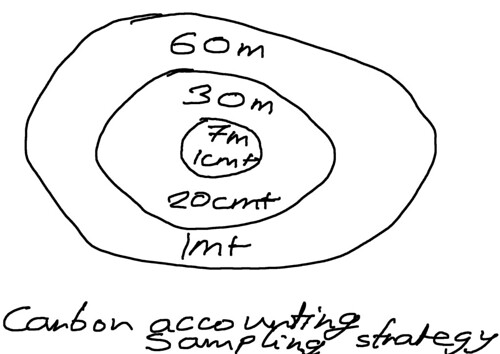
The tools of the trade are - diameter tape, study area marker ribbons and data collection sheets. The work area is laid out along the slope with tape and compass and the perimeter of the stratified sampling sites marked with ribbons.
The accommodation was in a set of ritzy bunks at Weldborough, followed by a second day of crawling around in Macquarie vines.
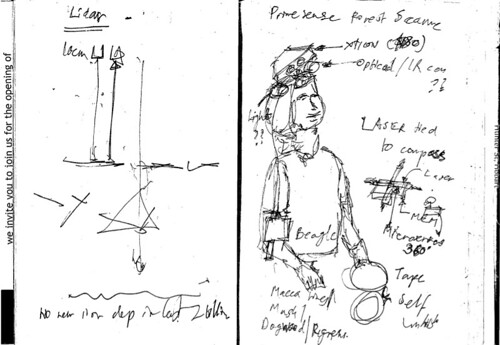
I managed to fit in some Gargoyle mode headgear design using the XTion and Infra-red cameras to document the forest. I hope to have a functional prototype before the next field trip. With enough data we may be able to solve allometric issues with smaller species such as tree-ferns and vines.

Wednesday, November 10, 2010

More Lollypop forests - in HFSS

HFSS Leafless Tree
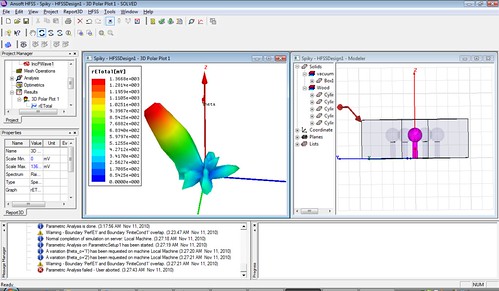
Heath from our lab gave me a primer in Ansoft HFSS and since then I have been muddling along to try and represent a forest for SAR imaging. I managed to get some of my ngPlant created models into it via STL from Blender, but beyond that HFSS was totally non-cooperative. The model refused to be healed to close any of the perceived holes etc. So my only option was ot make some Lollypop trees like before using the supplied primitives, in 3D this time. Fortunately HFSS allows quick duplication, scaling etc. of a single primitive and links them with transform nodes. In the future this will allow more stochastic forest generation rather than a cookie cutter one.
hfss lollypop trees

FEM kicks in beyond this point and calculates the scattered far fields with plane wave excitation. As expected due to the perfectly conducting ground plane most of the energy radiates away, but there is still some significant return towards the illuminating direction.The nice change from FEKO is that the fields are calculated in all directions, not just the illuminating direction. So this setup can be used to bistatic imaging scenarios as well.
ngPlant palm